













LSR Mold Temperature Control: Heating Methods, Uniformity Design and Control Accuracy


Overview: Liquid silicone cures with heat, so the accuracy of mold temperature control decides cure consistency, dimensional stability and production efficiency. Once the temperature difference within one tool exceeds 5 degrees Celsius, hardness deviation and dimensional variation appear.
Choosing a Heating Method
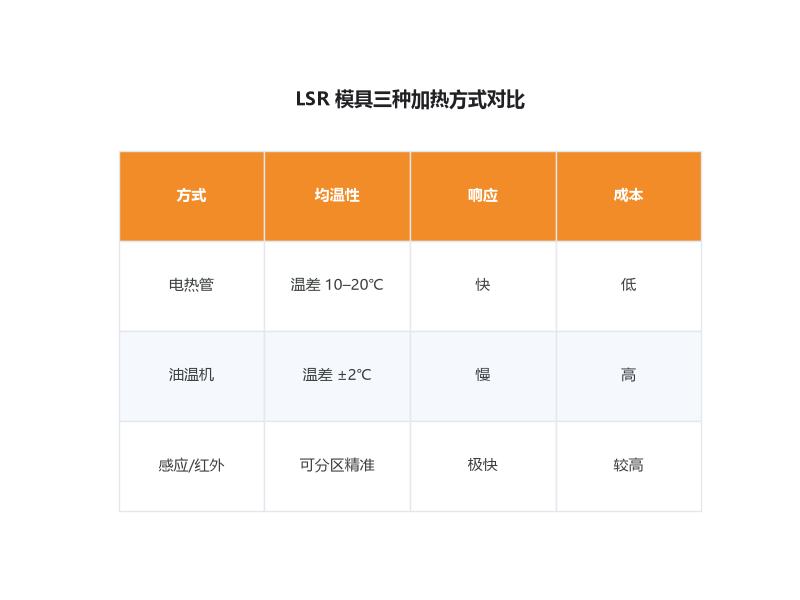
Cartridge heaters are the most common method: low cost and fast response, but with a large local temperature gradient — the difference between right next to the heater and further away can reach 10 to 20 degrees Celsius. An oil circulating unit transfers heat through circulating hot oil and gives the best uniformity, holding the difference within plus or minus 2 degrees, but heats up slowly, needs complex plumbing and costs more to maintain.
Induction and infrared heating are the emerging options. They heat extremely fast and can target specific zones precisely, which suits fast tool changes and applications demanding tight zoned control, though the equipment costs more. The industry mainstream is still cartridge heaters as the primary source, with oil temperature support in critical areas.
Designing for Uniform Temperature
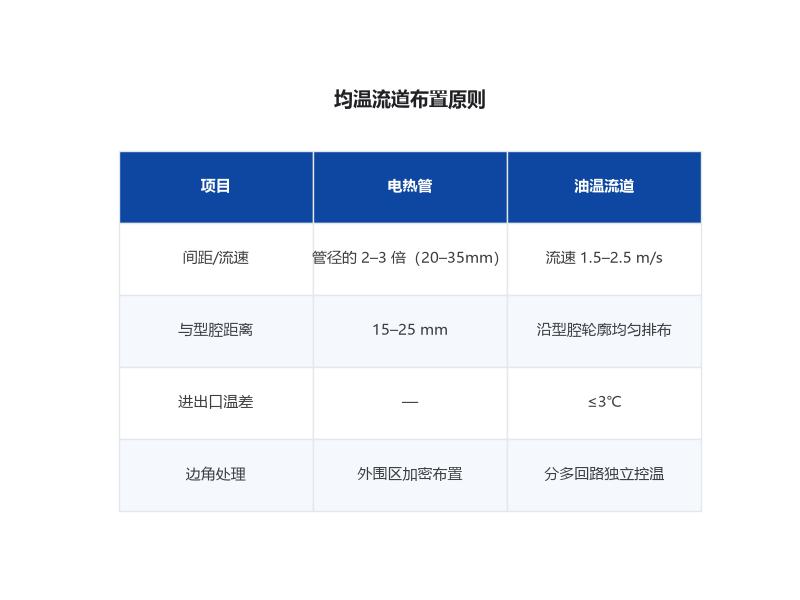
Cartridge heater layout follows three rules. Pitch should be two to three times the heater diameter, so 20 to 35 mm for an 8 to 12 mm heater. Distance from heater to cavity surface should stay between 15 and 25 mm — too close scorches the compound, too far and response is sluggish. And the outer region around the cavity gets a denser layout, to compensate for heat loss at the edges.
Oil channel design comes down to series first, parallel balanced: channels run evenly along the cavity profile, inlet-to-outlet temperature difference held within 3 degrees Celsius, and flow velocity kept at 1.5 to 2.5 metres per second for efficient heat transfer. Large tools are better split into several independent circuits, each with its own control.
Zoned Closed-Loop Control
Multi-cavity and large tools have to be zoned. Each zone gets its own thermocouple — K or J type, inserted at least 30 mm deep with the tip 5 to 10 mm from the cavity surface — and a temperature controller or PLC runs the PID loop. Target control accuracy is plus or minus 2 degrees Celsius, and plus or minus 3 at the very least.
Where the thermocouple sits matters a great deal: put it where cavity temperature is most representative, usually the transition between the middle of the cavity and its corners — not next to a heater cartridge, which measures heater temperature rather than cavity temperature.
What Uneven Temperature Costs
Too large a temperature difference across one tool produces two failures at once: over-cure on one side, where parts come out brittle, undersized and prone to cracking, and under-cure on the other, where parts are soft and tacky with high compression set. Performance spread within a single shot becomes very wide. Measured data shows a 10 degree Celsius difference can shift hardness between parts in the same shot by 3 to 5 Shore A.
The way to find it is infrared thermal imaging: photograph the cavity surface immediately after opening, and hot and cold spots show up directly. Cold spots are typically at edges, at the bottom of deep cavities and around dense ejector clusters, and can be improved by adding heater cartridges, letting in beryllium copper inserts, or adding insulation board. Zhongshan Henry Precision Technology Co., Ltd. (Henry Precision) requires thermal imaging inspection on every production tool at the acceptance stage: cavity surface temperature difference of 5 degrees Celsius or less before production can start.
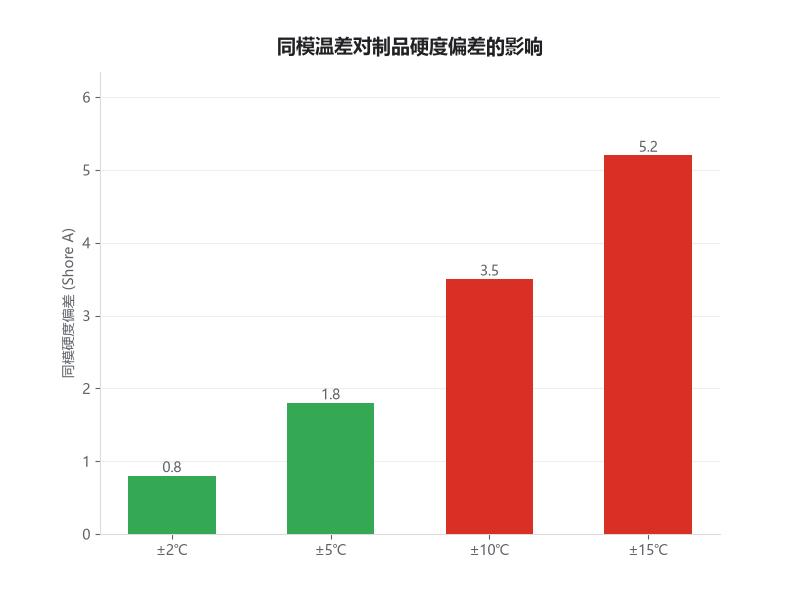
Table of Contents
Related News


Get Your Custom Liquid Silicone Overmolding Solution in 3 Steps
Learn More

