













Dimensional Stability and Tolerance Management for LSR Overmolded Parts


Where the Variation Comes From
The difficulty of holding dimensions in liquid silicone overmolding comes from the material itself. LSR has a coefficient of linear expansion of roughly 250 to 280 times 10 to the minus 6 per kelvin, close to twenty times that of tool steel, so a 50 mm silicone part drifts by more than 0.1 mm for every 10 degrees Celsius of ambient change. Cure shrinkage runs at 2.5 to 4 percent and varies with hardness, degree of cure and flow direction, and post-curing adds another 0.3 to 0.5 percent. On top of that, the rigid skeleton in an overmolded part constrains the silicone unevenly, so apparent shrinkage differs visibly between areas of the same part. Understanding where the variation comes from is a prerequisite for setting sensible tolerances and inspection conditions — silicone dimensional data without a stated temperature is meaningless.
Tolerance Design Principles
Tolerance should be set against ISO 3302-1, the dimensional tolerance standard for vulcanized rubber. Critical dimensions — sealing faces, assembly fits — are designed to class M2, which is plus or minus 0.05 mm for dimensions under 25 mm. Non-functional dimensions can be relaxed to class M4, plus or minus 0.10 mm or even 0.15 mm. Avoid placing accuracy requirements on large, unsupported silicone surfaces; where a precision fit is genuinely needed, let a rigid insert carry the dimension chain and leave the silicone to handle sealing and feel. Drawings must state the reference temperature, normally 23 degrees Celsius, and the measurement condition, and overmolded parts should be inspected after 24 hours of stabilization in a constant-temperature environment, so post-shrinkage and ambient temperature are taken out of the reading.
Shrinkage Compensation in Tooling
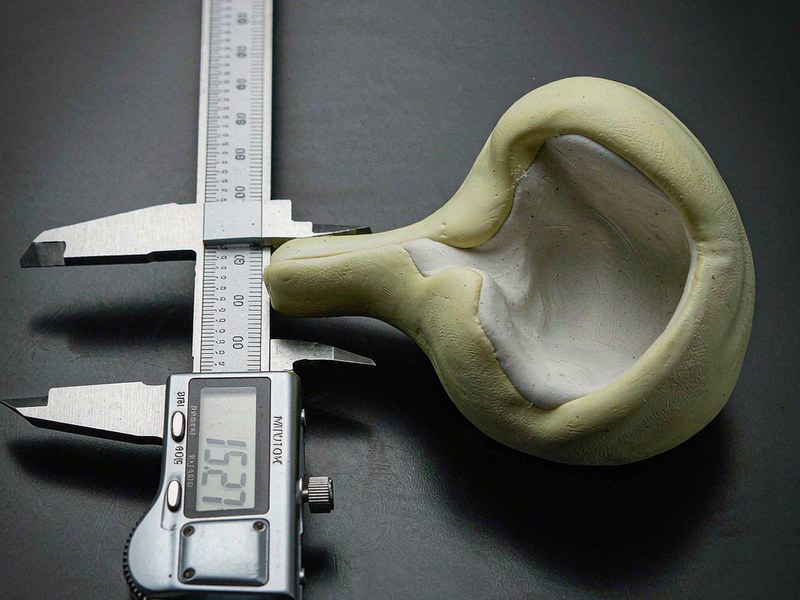
Cavity compensation is where most of the upfront effort goes in liquid silicone overmolding. The first tool is cut with the cavity scaled up by the median shrinkage figure from the material supplier, usually 3 percent. After the trial, full CMM data is used to back-calculate actual shrinkage at each feature, paying particular attention to the difference between flow direction and transverse direction, and between free and constrained shrinkage; a second tool correction is usually enough to bring critical dimensions close to the middle of tolerance. As a rule of thumb, apparent shrinkage in areas constrained by the rigid plastic runs 0.5 to 1 percent lower than in free areas. Leave correction allowance on the principle of adding rather than removing steel — cut the cavity small, then open it up, so a mistake never costs the tool.
Process Control and Inspection
Dimensional stability in production depends on parameter discipline and data monitoring. On the process side, three parameters are locked: mold temperature, held within plus or minus 5 degrees Celsius, cure time, and shot weight — drift in any of them shows up as shrinkage variation. For parts with tight accuracy requirements, a post-curing step of 4 hours at 200 degrees Celsius releases post-shrinkage before the part ships, so dimensions stop moving once the customer assembles it. On the inspection side, a CMM handles full first-article dimensional confirmation, and SPC monitors critical dimensions through production, sampling 5 parts every 2 hours. Process capability index Cpk is held above 1.33; anything below 1.0 triggers a parameter review. Zhongshan Henry Precision Technology Co., Ltd. has built a dimensional data chain linking temperature recorders, CMM and the SPC system, so Henry Precision's LSR precision overmolding production runs are traceable end to end — solid support for assembly stability in medical and automotive electronics work.
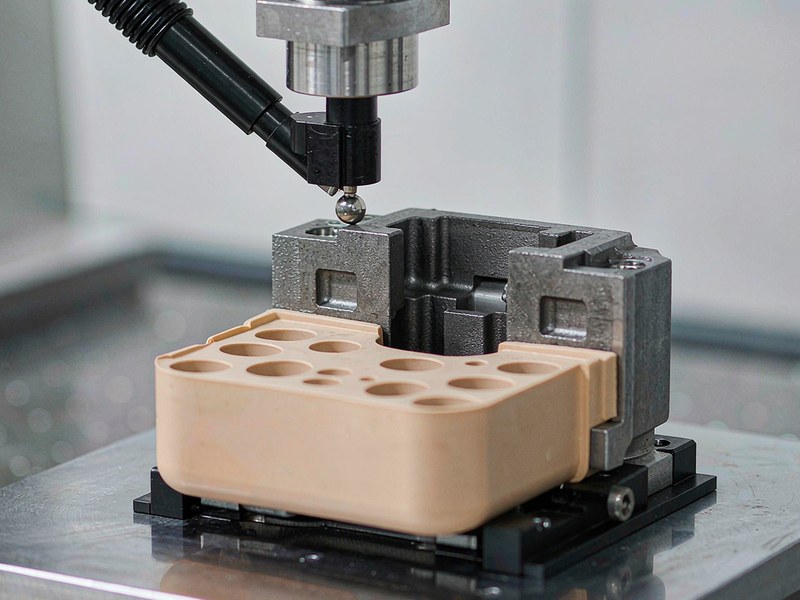
Table of Contents
Related News
-
Cleanroom Processing for LSR Precision Overmolding: Environmental Control and Contamination Prevention
Technical ArticlesLearn More
-
Dimensional Tolerance in LSR Precision Overmolding: How Micron-Level Accuracy Is Achieved
Technical ArticlesLearn More
-
LSR Grades and Shore Hardness: A Selection Guide from Food Contact to Medical
Technical ArticlesLearn More

Get Your Custom Liquid Silicone Overmolding Solution in 3 Steps
Learn More

