













Cosmetic Quality Control for LSR Overmolded Parts: From Mold Marks to Surface Defect Inspection


The Defect Spectrum
Cosmetic defects in liquid silicone overmolded parts fall into four families. Structural: parting line flash, gate marks, ejector pin marks and mold marks. Surface: water marks, flow lines, cold slug and local haze. Inclusions: black spots, foreign matter and gel particles. Colour: shade deviation and blotches. Each family points at a completely different part of the process. Parting line problems point at the tool and the clamping system. Water marks and flow lines usually trace back to poor venting or injection speed. Black spots and inclusions point at barrel purging and cleanroom discipline. The first step in cosmetic control is to build a defect atlas — a typical photograph, a size definition and a root cause direction for every defect type — so a defect report maps straight onto a corrective action.
Mold Marks and Parting Line Control
The parting line is the hardest cosmetic feature to remove from an overmolded part. The target is thin, straight and even. On the tooling side: parting face flatness within 0.005 mm, polished to Ra 0.4 micrometres or better, and clamping parallelism checked on a schedule. Once the mating face wears by 0.01 mm, visible flash appears, so high-volume tools need parting face maintenance every 100,000 shots. On the process side: leave 20 percent margin on clamping force and keep injection pressure under 20 megapascals, cutting overflow at source. On the finishing side: remove flash by cryogenic deflashing or careful hand trimming, never with a blade that can drag across the silicone surface. For class A cosmetic surfaces — the exposed face of a TWS earbud, for instance — the parting line can be moved to an edge or a non-visible area at the design stage, using geometry to solve what the process cannot.

Building an Inspection Standard
Cosmetic judgement has to be made objective, or two inspectors can differ by a factor of two. There are three levers. First, limit samples: for each defect type, prepare physical pieces sitting at the boundary between acceptable and unacceptable, sign them off with the customer, seal them as reference, then judge against them. Second, standardize the inspection conditions — illuminance of 1,000 to 1,500 lux, viewing distance of 30 cm, viewing angle of 45 degrees, no more than 15 seconds per part — so looking longer does not mean finding more. Third, grade the defects: set the permitted size and count separately for class A, class B and class C surfaces, for example no black spot above 0.2 mm on a class A surface. Once both sides have signed the standard, line and customer work to the same measure, and delivery disputes drop sharply.
Inspection and Closed-Loop Action
Manual inspection is subject to fatigue and mood, and typically catches only 85 to 90 percent. Where cosmetic requirements are high, it is worth bringing in an AI vision inspection system: multi-angle lighting and a high-resolution camera reliably pick up black spots, pitting and chipping at the 0.1 mm level, with detection above 99 percent and results recorded quantitatively. Inspection data should then flow back into a closed loop — pareto charts by defect type and cavity position identify the high-frequency cavity, and the tool gets targeted maintenance. Zhongshan Henry Precision Technology Co., Ltd. runs a three-part cosmetic control system in LSR precision overmolding production, combining a defect atlas, limit samples and 100 percent AI inspection, and Henry Precision holds the cosmetic batch rejection rate on liquid silicone overmolding parts for consumer electronics and medical customers below 0.3 percent, cutting incoming inspection cost at the customer end.
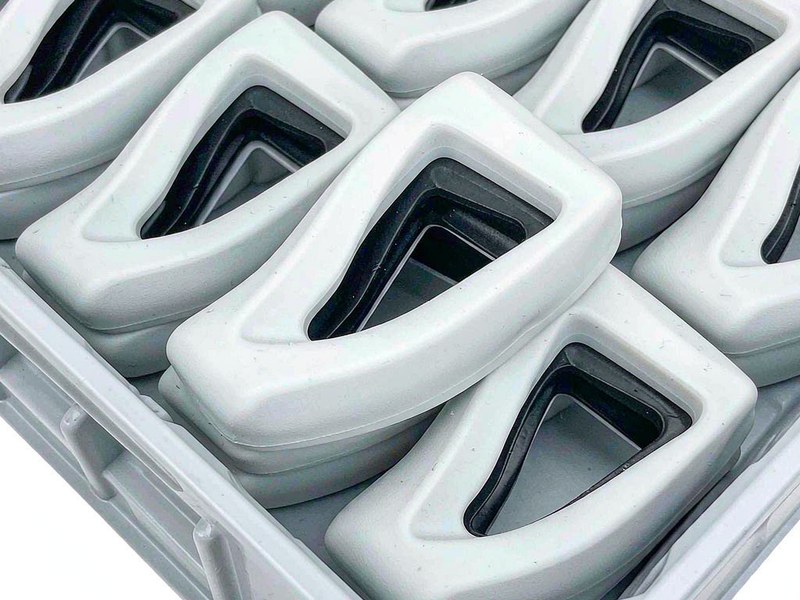
Table of Contents
Related News
-
Cleanroom Processing for LSR Precision Overmolding: Environmental Control and Contamination Prevention
Technical ArticlesLearn More
-
Dimensional Tolerance in LSR Precision Overmolding: How Micron-Level Accuracy Is Achieved
Technical ArticlesLearn More
-
Designing an Automated LSR Overmolding Line: Flexible Tool Change in Practice
Technical ArticlesLearn More

Get Your Custom Liquid Silicone Overmolding Solution in 3 Steps
Learn More

