













Choosing Tool Steel for LSR Overmolding: S136, NAK80 and Heat Treatment


Overview: Steel for liquid silicone tooling has to satisfy four demands at once: wear resistance, corrosion resistance, polishability and thermal conductivity. Pick wrong and the consequences are immediate — early cavity wear generates flash, mirror-finish parts never reach the required surface quality, or acidic by-products etch rust spots into the steel. Different production volumes and compound hardnesses call for different economic answers.
Four Common Steels
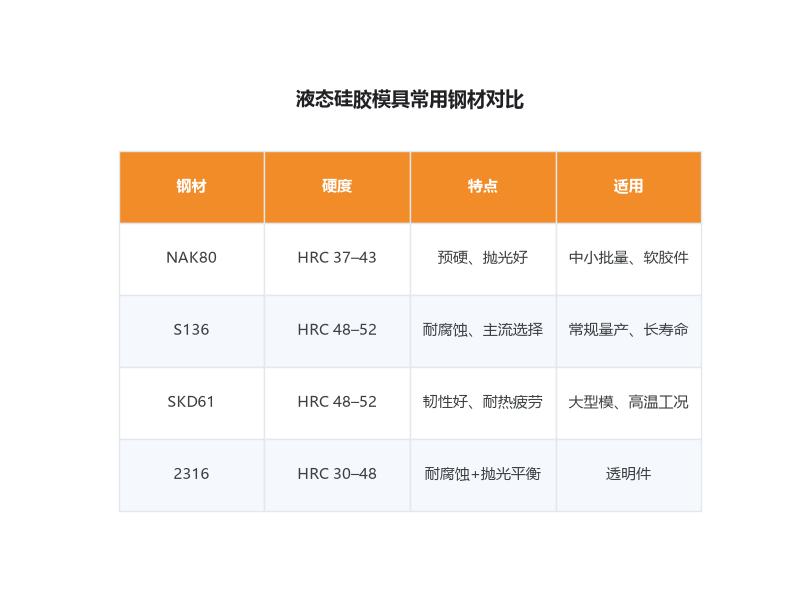
NAK80 is a pre-hardened mirror-finish plastic mold steel, supplied at HRC 37 to 43. It machines without heat treatment and polishes well, which suits small to medium runs, up to 300,000 shots, and soft-rubber parts with demanding appearance requirements. On cost-performance it is the strongest option.
S136 (equivalent to 1.2083, the 420 series) is a martensitic stainless steel that reaches HRC 48 to 52 after quenching. Its corrosion resistance is excellent, which is why it is the mainstream choice for LSR tooling where the compound is aggressive or a long tool life is required. SKD61 (H13) offers good toughness and thermal fatigue resistance, suiting large tools and high-temperature duty. 2316 strikes a balance between corrosion resistance and polishability, and is often used for transparent parts.
What Heat Treatment Does
S136-type steels are normally quenched and double tempered to a target hardness of HRC 48 to 52. Below 46, wear resistance is inadequate and the cavity is liable to collapse at the parting face; above 54, toughness falls away and thin-wall inserts and sharp corners become a cracking risk.
Dimensional stability after heat treatment matters just as much. Stress-relief annealing after rough machining is recommended, followed by a deep cryogenic treatment, minus 70 to minus 196 degrees Celsius, after quenching and tempering. That markedly reduces retained austenite and limits dimensional drift over a long service life.
Polishing and Coatings
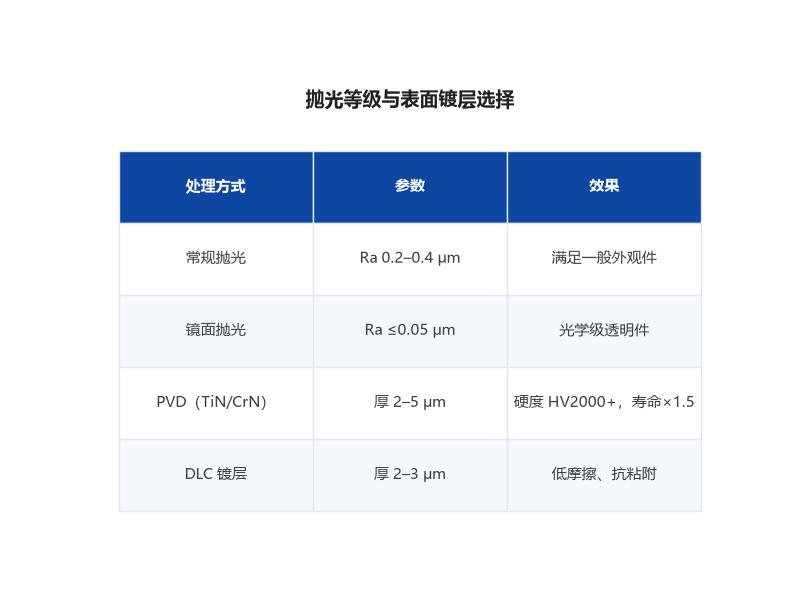
A silicone part replicates the cavity directly, so the polish grade sets the appearance of the product. Standard parts are fine at Ra 0.2 to 0.4 micrometres. Mirror-finish transparent parts call for Ra of 0.05 micrometres or better, worked up through 400, 800, 1200 then 2000 grit and finished with diamond paste. One caution: S136 has a high chromium content and is prone to orange peel during polishing, so grinding pressure and direction have to be controlled.
For highly abrasive compounds, high hardness or heavily filled, PVD (TiN, CrN) or DLC coatings raise surface hardness above HV 2000 and extend tool life by 1.5 to 2 times. Coating thickness is generally 2 to 5 micrometres, which does not affect dimensions.
Thermal Conductivity and Heating
LSR cures with heat rather than being cooled, so the thermal conductivity of the tool steel is often overlooked. In reality, an even mold temperature distribution is critical to cure consistency — a difference of more than 5 degrees Celsius gives different cure levels within the same shot, showing up as hardness deviation and dimensional variation.
On conductivity, beryllium copper (BeCu) runs at roughly 105 watts per metre-kelvin, far above S136 at about 20. Where there is a local hot spot, or a position where a heater cartridge cannot be placed, a BeCu insert can be let in to even out the temperature quickly. Zhongshan Henry Precision Technology Co., Ltd. (Henry Precision) uses this combined approach — S136 as the main steel with local BeCu inserts — as standard practice on large and multi-cavity tools.
Table of Contents
Related News
-
Precision Tooling for LSR Overmolding: Cold Runner, Cavity and Demolding, End to End
Technical ArticlesLearn More
-
Tooling Essentials for LSR Precision Overmolding: Gate, Venting and Parting Line
Technical ArticlesLearn More
-
Key Points in Tooling Development for Medical LSR Overmolding
Industry InsightsLearn More

Get Your Custom Liquid Silicone Overmolding Solution in 3 Steps
Learn More

