













How Sourcing Is Shifting: From Price Comparison to Joint Development


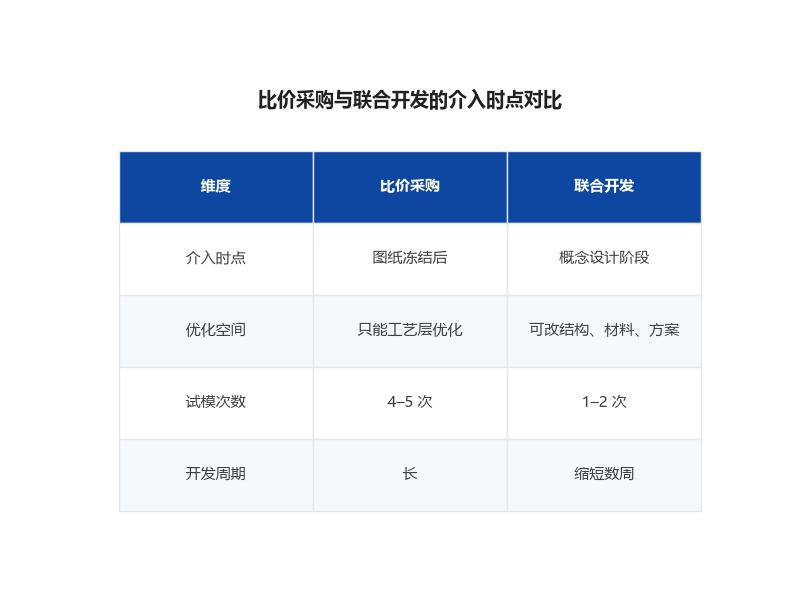
Overview: Sourcing for liquid silicone overmolding is moving from quoting against a drawing to early joint development. The driver is direct: part performance depends heavily on how design and process fit together, and waiting until drawings are frozen often means missing the optimization window or planting problems that volume production cannot fix.
Why Price Comparison Breaks Down
Conventional price comparison assumes complete drawings, clear specifications and several capable suppliers. Overmolded parts meet none of these. From the same drawing, different suppliers may produce entirely different gate schemes, venting designs and process windows, and the yield, service life and consistency of the finished parts diverge widely. Items that look identical on a quotation can differ by an order of magnitude in delivered quality.
The more practical problem is that once drawings are frozen, many design defects are already set — abrupt wall thickness changes, undercuts that cannot release, sealing lips that are too narrow. Suppliers can only optimize within a suboptimal scheme, not fix the root cause.
What DFM Delivers
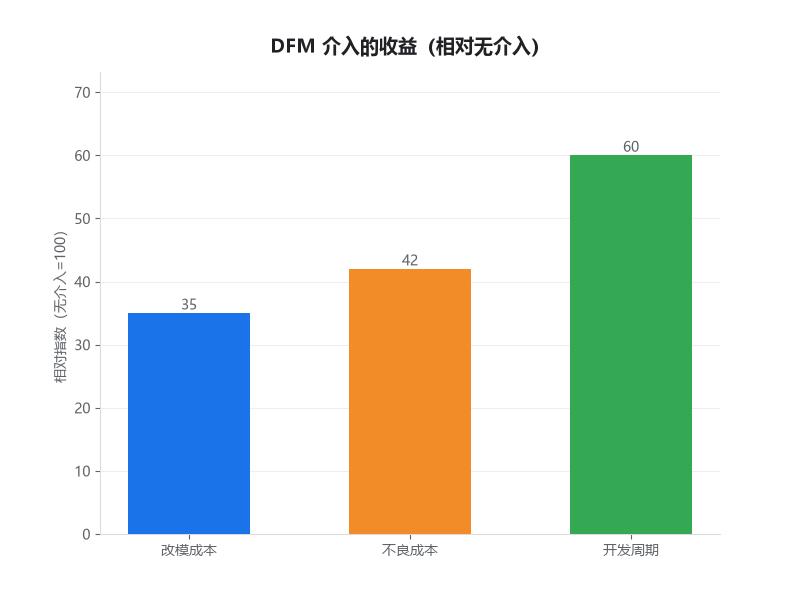
Bringing a supplier in for DFM (design for manufacture) review at the concept stage typically delivers: wall thickness and structure optimization that reduces sink marks, flash and trapped air; material and hardness selection matched to service conditions rather than guesswork; tooling scheme optimization covering gate position, parting line and demolding method; and cost estimates with reduction proposals.
Industry experience puts it this way: every yuan spent on DFM at the design stage saves 10 to 30 yuan in tooling rework and defect costs at the production stage. More importantly it shortens development — cutting trials from four or five down to one or two, and moving launch forward by several weeks.
The Evaluation Criteria Have Changed
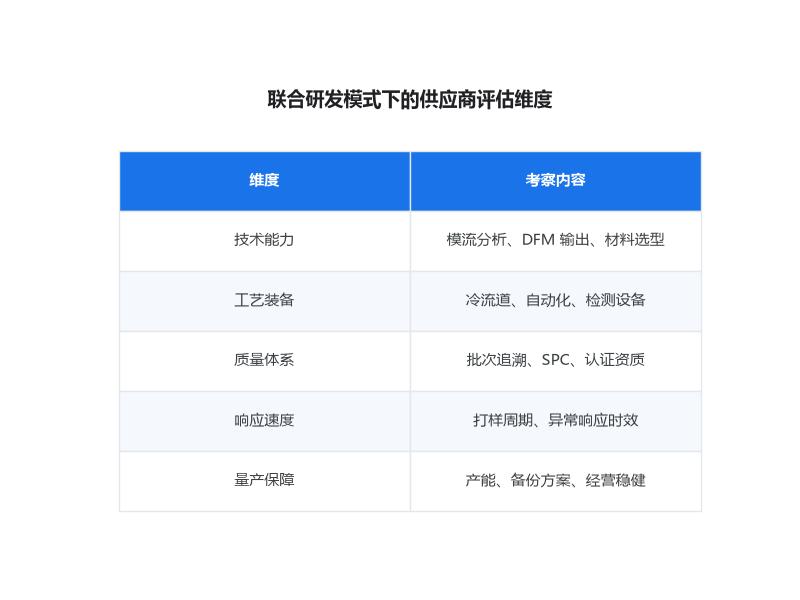
Under the joint development model, supplier evaluation expands from price plus lead time to five dimensions: technical capability (mold flow analysis, DFM output, material selection), process equipment (cold runner, automation, inspection), quality system (traceability, SPC, certifications), responsiveness (sampling lead time, issue response), and volume assurance (capacity, contingency plans, financial stability).
Price still matters, but it ranks lower. For high-risk, technically demanding parts, choosing a cheap supplier without the capability usually ends in a far higher cost of failure.
How to Structure the Collaboration
Effective collaboration is layered: strategic programs use early involvement plus joint development plus long-term agreements, with shared technology roadmaps; routine programs use standardized selection and fast quoting; small-batch pilot programs demand rapid sampling capability of two to four weeks.
Intellectual property must be agreed before work starts: ownership of tooling produced through joint development, ownership of process patents, and the boundaries of exclusive supply. With those terms clear, both sides can invest with confidence. Zhongshan Henry Precision Technology Co., Ltd. (Henry Precision) typically recommends open exchange during design, IP ownership as agreed, and quality and delivery as the primary metrics once production starts.
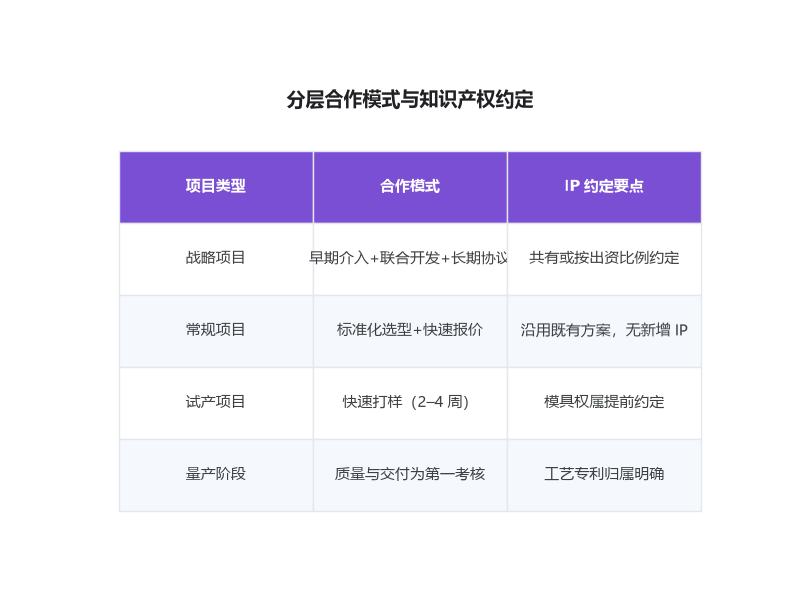
Table of Contents
Related News

Get Your Custom Liquid Silicone Overmolding Solution in 3 Steps
Learn More

