













Do LSR Overmolded Parts Smell? How VOC and Odour Are Controlled


Overview: a properly cured platinum-cure LSR part has very low odour of its own. What smell there is comes mainly from low molecular siloxanes (D3-D10) that have not fully reacted, plus residues from processing aids. With post-curing, material screening and packaging control, VOC can be brought within automotive and baby care limits. Odour control comes down to two steps — remove it in the process, then close the loop with testing — not simply airing parts out.
Where the Odour Comes From
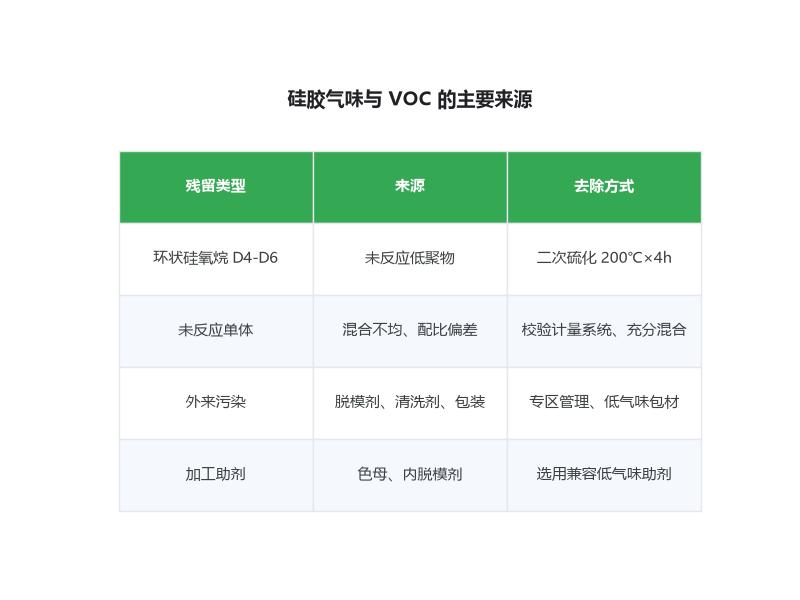
Platinum addition curing produces no by-products in theory, but three kinds of residue remain in practice: cyclic siloxane oligomers that never took part in crosslinking (mainly D4, D5 and D6); locally unreacted monomer caused by uneven mixing of the A and B components; and external contamination from release agents and cleaning agents. The oligomers are the main contributors to both odour and VOC.
Grades differ widely here: a general-purpose industrial LSR typically has 0.5%-1% volatiles, while automotive and medical-grade grades can be held below 0.2%. If the product is odour-sensitive, specify a low-volatile grade at the material selection stage.
Post-Curing to Remove Odour
Post-curing is the most effective way to remove low molecular content: hold the parts in an oven at 180-200°C for 2-4 hours so the oligomers volatilize fully. Measured data shows that after 200°C for 4 hours, total volatiles drop from 0.6% to below 0.15%, and the odour rating falls from level 4 to within level 2.
The result depends heavily on how the oven is loaded: parts must be laid out in a single layer with gaps between them, and the oven needs forced hot air circulation with adequate air exchange. Stacked loading means the parts in the middle get almost no benefit.
Setting the Test Standard
Automotive work commonly uses VDA 270 (odour rating 1-6, typically requiring ≤3) and VDA 278 (TVOC/FOG thermal desorption analysis). Electrical and electronics refer to GB/T 27630 or an in-house bag method. Food contact and baby care products test potassium permanganate consumption, heavy metals and specific migration limits.
We recommend writing into the drawing or technical agreement: the standard applied, the limits, and the sampling batch and frequency. Batch sampling matters particularly — odour problems usually come from raw material batch variation, so first-article inspection alone is not enough. Zhongshan Henry Precision Technology Co., Ltd. (Henry Precision) keeps a retained sample from every batch on low-odour projects and commissions third-party retesting quarterly.
Packaging and Transport
Quite a few odour complaints originate after the parts leave the factory: sealing them in ordinary PE bags traps residual volatiles against the surface, so the smell releases all at once when the box is opened, and the odour of the carton and foam itself can migrate and adsorb onto the silicone. Low-odour products should use breathable packaging, or be cooled and aired before sealing, with low-odour materials for the outer carton.
For extremely odour-sensitive products such as automotive interior parts, you can ask the supplier to leave parts standing for 24-48 hours after post-curing before packaging, so surface residue disperses further.
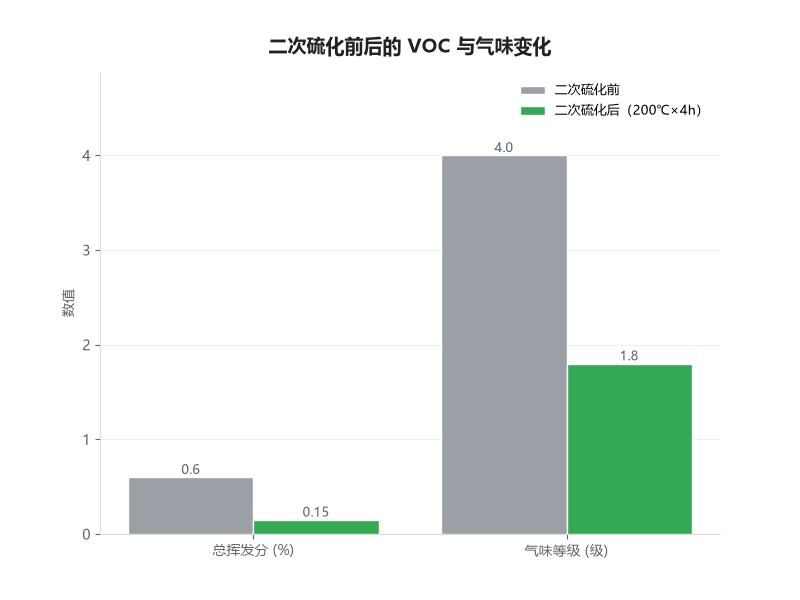
Table of Contents

Get Your Custom Liquid Silicone Overmolding Solution in 3 Steps
Learn More

