













Can LSR Overmolding Be Transparent? Clarity and Colour Matching Explained


Overview: liquid silicone can be highly transparent in itself, but the clarity of a finished overmolded part depends on four things: the material grade, the mold polish level, cure temperature and the post-curing process. What most customers call "not transparent" is actually haze caused by a rough cavity surface or over-curing. Henry Precision can propose a workable process route between translucent, high-transmission and opaque, depending on what the part is for.
The Upper Limit on Clarity
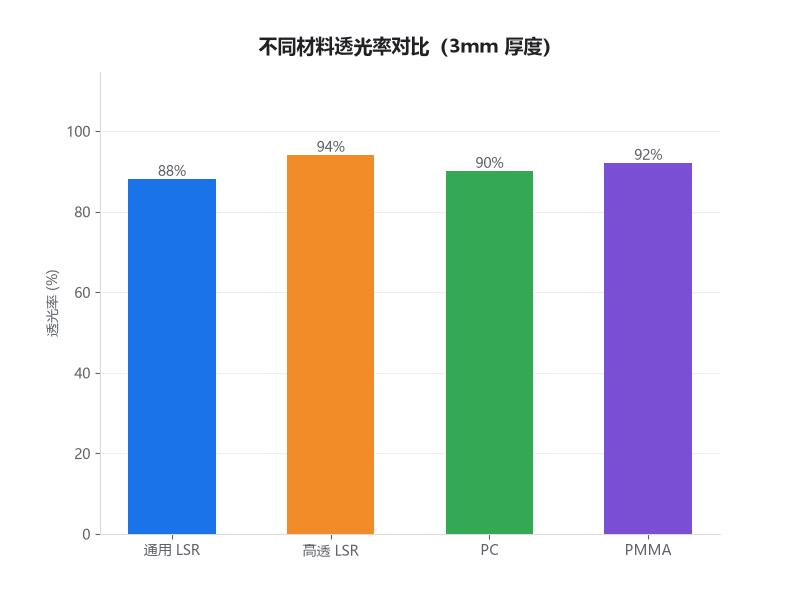
General-purpose LSR typically transmits 85%-92% of light; dedicated high-transmission grades (some fumed silica systems) exceed 93%, approaching optical-grade PC. One distinction matters: material transparency is not the same as finished-part transparency. A 1 mm thick plaque may test very clear, but made into a 3 mm wall with curvature and texture, the same material looks visibly whiter and hazier — the result of a longer light path combined with internal scattering.
If the part is a light guide, a sight window or a sensor transmission window with optical requirements, lock in a high-transmission grade at the material selection stage and ask the supplier for haze data at the same wall thickness. Transmission alone is not enough.
The Effect of the Cavity Surface
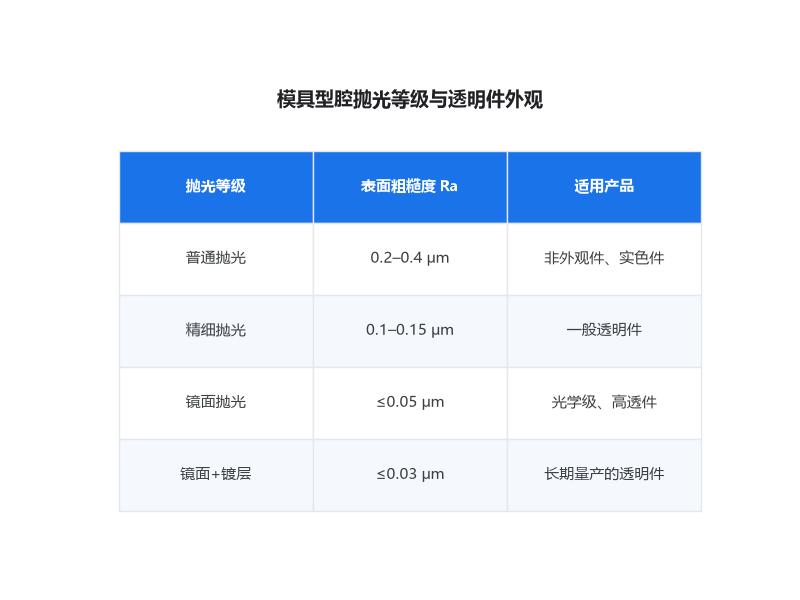
Clarity in an overmolded part is largely determined by the cavity surface. Polished to a mirror finish (Ra ≤ 0.05 μm), the material replicates a smooth surface and transmits light evenly. At an ordinary polish (Ra 0.2-0.4 μm), or with EDM or tool marks, the finished surface is microscopically uneven and diffuse reflection produces white haze. For transparent parts the cavity must be mirror polished as a separate operation, with the polishing direction along the draw, avoiding transverse marks.
Another point that is easy to overlook is venting. Vent grooves of 0.01-0.02 mm are cut into the parting line to release trapped air, but they leave visible lines at the edge of a transparent part, so vents should be placed on non-appearance faces wherever possible.
Curing and Haze
A platinum cure system does not produce the yellowing by-products that peroxide curing does, but excessive cure temperature or time will still cause a slight rise in haze. We generally recommend holding mold temperature at 150-180°C, with cure time set at roughly 5-10 seconds per 1 mm of wall thickness to avoid over-curing.
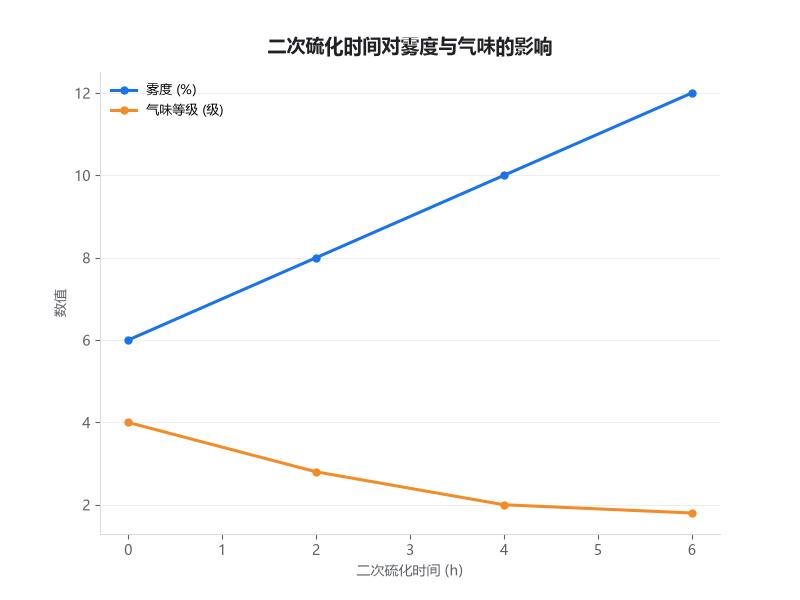
Post-curing (200°C for 4 hours) is a double-edged sword for transparent parts: it removes low molecular volatiles effectively and reduces odour, but it also raises haze by 2-5 percentage points on some grades. If the product does not have demanding odour requirements but does need maximum clarity, you can agree with the supplier to waive post-curing or shorten it to 200°C for 2 hours. Zhongshan Henry Precision Technology Co., Ltd. (Henry Precision) runs trial comparisons of three different process routes on transparent parts before committing to one.
How Colour Matching Works
LSR is coloured by adding a masterbatch (colour paste) as the A and B components are mixed, typically at 0.5%-3%. Three cautions: the masterbatch must be compatible with the platinum system — sulphur- or amine-containing pigments poison the catalyst and prevent curing. Dark colours, particularly black and deep blue, slow the cure noticeably and need correspondingly longer cure time. Fluorescent and metallic colours are less stable in silicone and fade under prolonged light, so use them with care on outdoor parts.
For a light or semi-transparent effect on a transparent part, use a transparent base compound with a low masterbatch ratio, and approve a 2 mm plaque first — the colour after molding looks deeper and duller than the masterbatch itself.
Acceptance and Control
Incoming acceptance on transparent parts should look at three measures together: transmission, haze and yellowness index (YI). Keep a retained sample from every production batch and measure on the same spectrophotometer to avoid systematic variation between instruments. Appearance faces should also be checked in a standard light booth against a black background for white spots, flow marks and bubbles — defects of this kind are magnified on transparent parts.
When writing clarity requirements into a drawing, do not simply say "transparent". State: transmission ≥ XX% (to ASTM D1003 at X mm thickness), haze ≤ XX%, and no visible point defects larger than 0.1 mm on appearance faces. With the figures stated, both sides have a common basis for judgement.
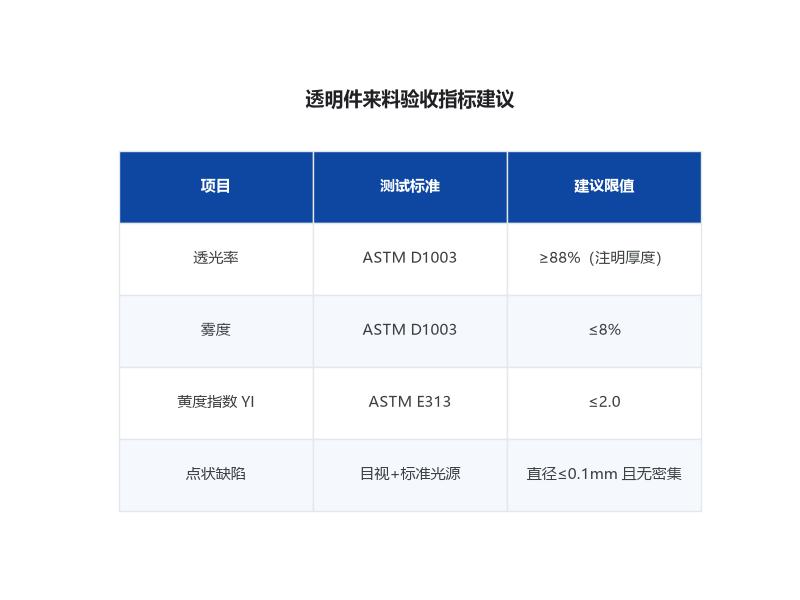
Table of Contents
Related News
-
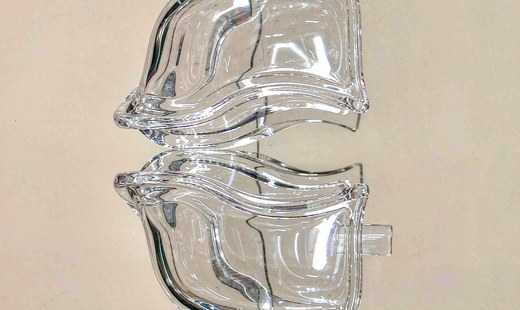
Can LSR Overmolding Produce Transparent Parts? How Is Clarity Controlled?
FAQSLearn More
-
LSR Precision Overmolding for Optical Lighting: Light-Transmitting Seals and Thermal Protection
Industry InsightsLearn More
-
LSR Grades and Shore Hardness: A Selection Guide from Food Contact to Medical
Technical ArticlesLearn More

Get Your Custom Liquid Silicone Overmolding Solution in 3 Steps
Learn More

