













DFM Design Guide for Medical LSR Overmolding: Eight Hidden Traps to Avoid at the Design Stage


New medical device development runs on tight timelines, and product engineers often concentrate on function and appearance while giving too little thought to the manufacturing constraints of LSR liquid silicone overmolding. Once drawings are frozen and tooling is cut, problems such as debonding, bubbles, flash and stress cracking appear — and reworking a medical tool takes a long time, which directly slows product registration.
DFM — design for manufacture — means anticipating risk at the early design stage, using the characteristics of the LSR process. As a leader in medical liquid silicone precision overmolding, Zhongshan Henry Precision Technology can join a customer's DFM review before a program starts, removing a large share of downstream problems at the source.
The Value of DFM Review
LSR liquid silicone has low viscosity and extremely high flow, while medical products impose strict demands on dimensional accuracy, bond reliability and sterilization resistance. A structure achievable in a cosmetic prototype is not necessarily suited to automated production in the hundreds of thousands. DFM is not simply a drawing check — it is a combined assessment of material behavior, tooling feasibility, automated production and later sterilization and aging conditions.
Mechanical Interlock Design
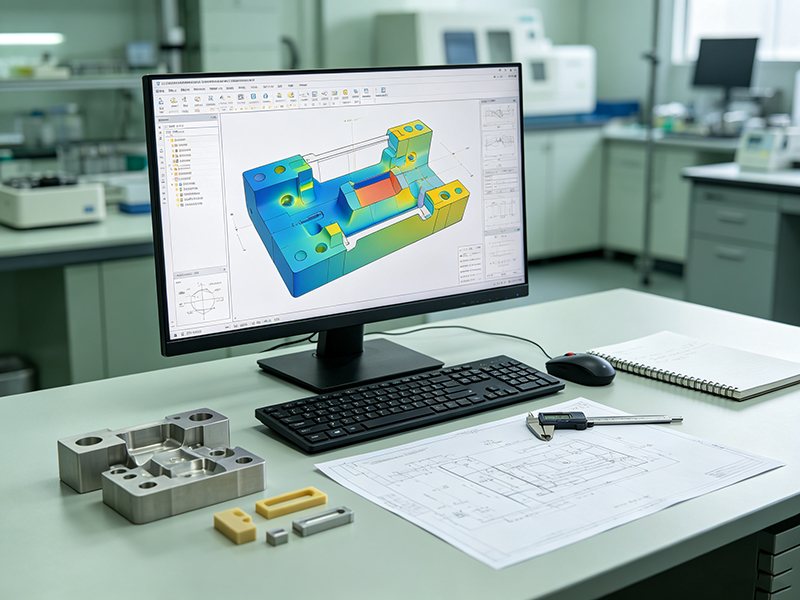
Many overmolding jobs on hard-to-bond substrates such as PPSU and PEEK rely only on plasma and primer for chemical bonding, without grooves or through-holes for mechanical locking. After repeated EO sterilization and thermal cycling, stress accumulates at the interface and hidden delamination appears. For high-reliability medical programs, whichever bonding route is chosen, adding a mechanical interlock as a safety margin is recommended.
Silicone Wall Thickness Control
LSR wall thickness should not be excessive — locally exceeding 4 mm risks incomplete curing and sink marks — while a layer that is too thin, especially under 0.3 mm, tends to short fill. For medical overmolding, keeping the layer between 0.5 and 2.5 mm is recommended, with thickness as uniform as possible and no abrupt transitions.
Fillets to Relieve Stress
Where silicone meets a rigid substrate, sharp right angles are not acceptable. Repeated heating and cooling from sterilization concentrates stress exactly at sharp corners, and the silicone cracks over time. Every soft-rigid junction needs a fillet transition to release internal stress and extend product life.
Insert Locating Design
Inserts can be placed by hand during sampling, but in million-piece automated production they need locating holes and steps. If the drawing leaves no locating feature, the only options are reworking the insert or even cutting a new insert tool. Since medical programs are built for volume, automated placement has to be considered from the start.
Shut-Off Boundary Treatment
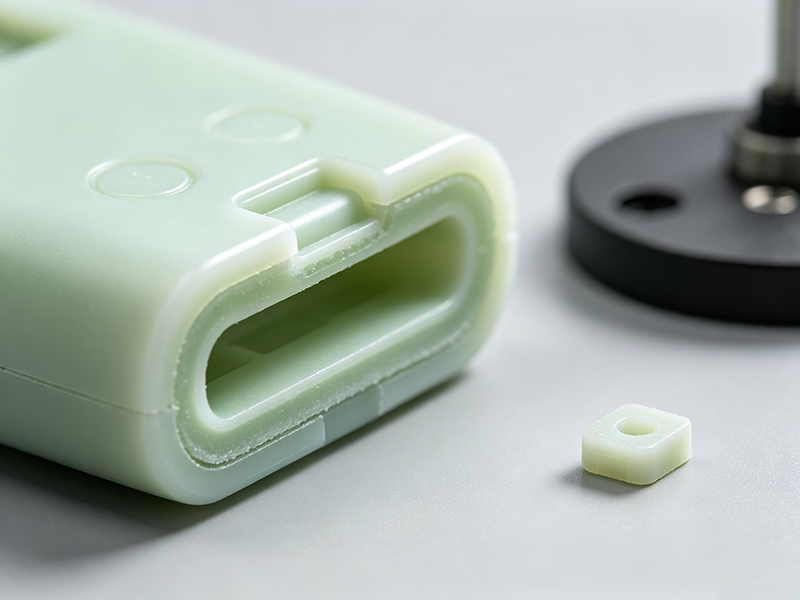
LSR flows extremely easily, so if the shut-off line sits on a mating assembly surface, micro flash appears that is very hard to remove on small medical parts. Place the shut-off boundary away from assembly or cosmetic areas to make tooling easier and limit the effect of bleed on assembly performance.
Thermal Expansion Mismatch
The coefficients of thermal expansion differ greatly between LSR silicone, PPSU, PC and stainless steel. Repeated heating and cooling during sterilization keeps pulling at the bonded interface. Thermal stress should be evaluated at the DFM stage — not just room-temperature bond strength, but the full sterilization cycle simulated.
Cavity Venting Design
When silicone covers deep grooves or sealed narrow cavities, trapped air cannot escape, producing bubbles and short shots. Many of these geometries look fine in a prototype but get amplified in a multi-cavity production tool, so mold flow analysis should be used to identify air traps in advance.
Production Validation
Plenty of development teams pass every test on small-batch prototype samples, then see batch failures once incoming tolerances vary in production. Alongside the DFM review, insert tolerances and surface quality standards need to be defined, with reliability testing run under simulated production incoming conditions.
Working With a Partner
Henry Precision can step in early on a medical LSR overmolding program to join the customer's DFM review, combining mold flow simulation with medical production experience to deliver a DFM report that flags structural risks and gives revision advice — intercepting risk before tooling is cut, shortening device development cycles and reducing rework cost.
Table of Contents



Get Your Custom Liquid Silicone Overmolding Solution in 3 Steps
Learn More

