













Industrial Connectors and Wire Harnesses: Weather-Resistant Overmolding for Heavy-Duty Service


Overview: The joints in industrial connectors, EV high-voltage harnesses and outdoor telecom base stations all have to stay sealed long-term through vibration, temperature swings, humidity and chemical exposure. Failure in these applications is extremely costly, which is pushing overmolding programs from adding a seal toward one-piece overmolding.
Operating Conditions and Challenges
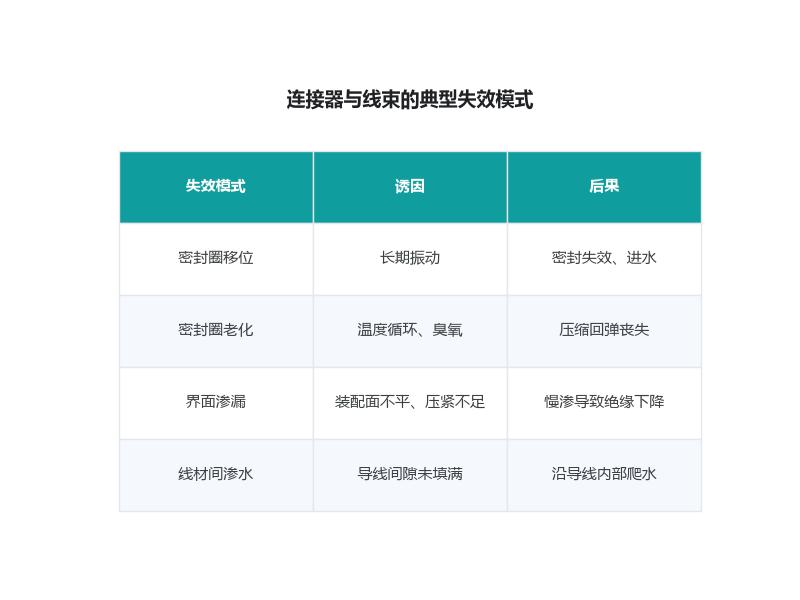
Typical service for industrial connectors and harnesses means sustained vibration (especially in vehicles and construction equipment), thermal cycling from -40 to 125 degrees Celsius, humidity and salt spray, and contact with oil and chemicals. The conventional approach fits an independent rubber seal, but under sustained vibration that seal shifts, wears and ages until sealing fails.
The cost of failure is high: water entering a single connector can stop an entire production line, or trigger an insulation fault in an EV high-voltage system. In these applications, sealing reliability is worth far more than the part cost.
Why One-Piece Overmolding
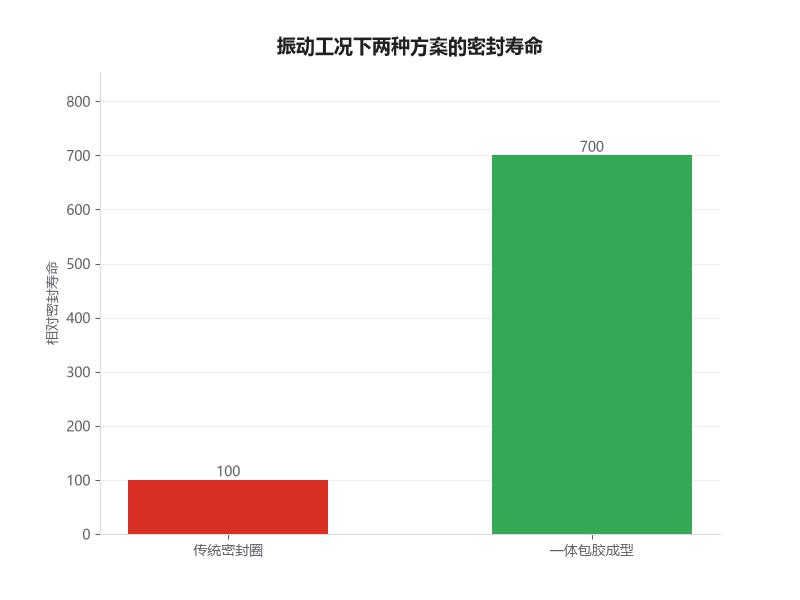
Molding the sealing structure together with the harness or connector housing removes the assembly interface — no interface means no interface leakage and no seal displacement. Test data shows that under vibration (10-2000 Hz, 20 g), a one-piece overmolded design lasts 5 to 10 times longer than a conventional seal.
One-piece molding also simplifies assembly, cuts part count and reduces human assembly error. For high-volume applications the total cost comes out lower.
Implementation Essentials
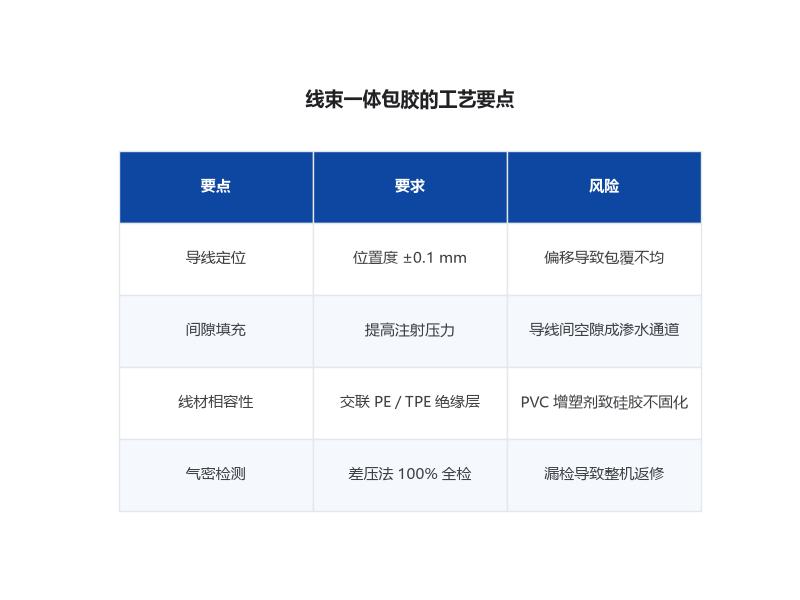
The key to harness overmolding is locating and sealing the wires: multiple conductors must be positioned precisely in the cavity (within plus or minus 0.1 mm), and the gaps between individual wires must also be filled, or a water path forms. In practice, comb-shaped locating blocks or staged fixtures are used together with higher injection pressure to ensure the gaps fill.
Compatibility between the compound and the wire insulation also matters: plasticizers in PVC insulation can migrate and stop the silicone from curing, so cross-linked PE or TPE insulated wire without plasticizers should be specified. This is the most common source of process failure in harness overmolding.
Trends and Opportunities
Three trends are driving this market. First, EV high-voltage harness count and voltage levels keep rising, and 800 V platforms place far higher demands on sealing and insulation. Second, 5G and data center build-out is driving demand for outdoor communication equipment connectors. Third, industrial automation and robotics are increasing cable sealing demand.
For suppliers, the opportunity lies in offering an integrated overmold-plus-test package: leak testing and withstand voltage testing right after molding, delivering a validated assembly rather than a loose part. Zhongshan Henry Precision Technology Co., Ltd. (Henry Precision) is moving leak testing capability forward into the molding step to give connector and harness customers one-stop delivery.
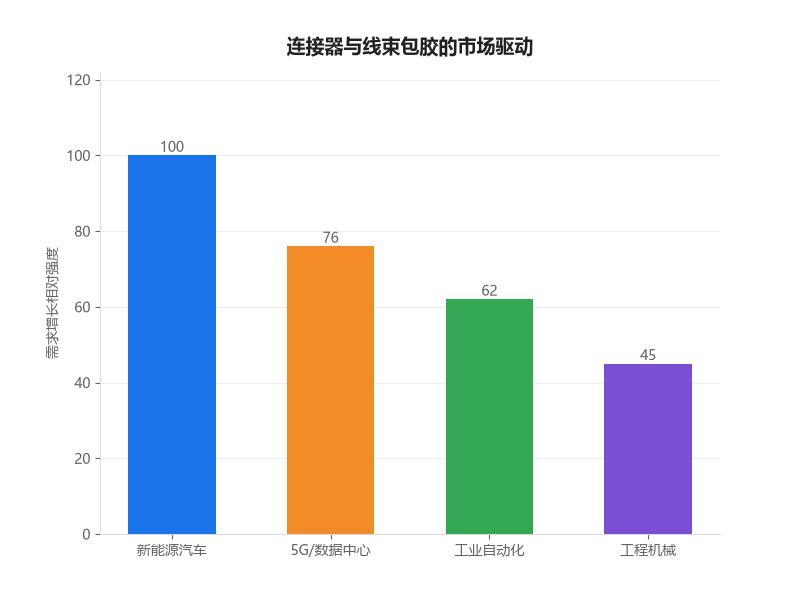
Table of Contents
Related News
-
LSR Precision Overmolding for Communications Equipment: 5G Base Station Sealing and EMC
Industry InsightsLearn More
-
What Operating Conditions Can High-End Industrial Seal Overmolding Handle?
FAQSLearn More
-

LSR Precision Overmolding for Bathroom and Plumbing: Durable Sealing and Corrosion Resistance
Industry InsightsLearn More

Get Your Custom Liquid Silicone Overmolding Solution in 3 Steps
Learn More

