













LSR Precision Overmolding for New Energy Vehicles: Sealing the Three-Electric System


1. Industry Context: From Optional to Essential
As new energy vehicle penetration climbs, vehicle voltage platforms are moving from 400 V to 800 V and beyond. That jump means every high-voltage connector, every harness and every battery pack seam has to meet higher insulation requirements and harsher thermal stress. Industry data shows an average new energy vehicle uses 200-500 g of liquid silicone, three to five times more than a conventional combustion vehicle, with annual growth above 35 percent. LSR precision overmolding is shifting from an optional extra to an essential part of three-electric system packages.
2. Three-Electric Systems: Where Demand Concentrates
The three-electric system refers to the traction battery, drive motor and electronic control unit — the hub where vehicle energy is stored, converted and managed. The battery pack needs long-term water and dust protection plus resistance to electrolyte and coolant corrosion. The motor generates high temperatures and heavy vibration at high rpm. The electronic control unit packs a large number of precision chips and high-voltage power devices. All three concentrate demand for sealing, insulation, thermal conduction and damping — exactly where LSR precision overmolding delivers the most value.
3. Sealing Pain Points: Three Failure Modes of Conventional Approaches
In the combustion vehicle era, standard EPDM or solid silicone met most sealing needs. But the high-voltage environment of new energy vehicles exposed three fatal weaknesses. First, thermal expansion and contraction under extreme temperature swings — a connector can jump from minus 40 to 150 degrees Celsius in a very short time, and a mechanically fitted seal easily shifts, ages and cracks. Second, the challenge of high-pressure washing — parts must pass IP69K high-temperature high-pressure water jet testing, which conventional assembly gaps cannot withstand. Third, assembly difficulty with complex structures — parts keep getting smaller and structures more complex, so manually fitting tiny seals is inefficient and hard to hold at acceptable yield.
4. One-Piece Molding: Removing Leak Paths at the Source
The core of LSR precision overmolding is one-piece molding. Inside the precision injection machine, liquid silicone is injected directly onto metal terminals or plastic housings already placed in the tool, crosslinking chemically at high temperature and finally becoming one with the substrate. This differs fundamentally from the conventional mold-then-fit assembly approach: one-piece molding leaves no joint gap, removing at source the capillary paths that cause micro leakage, and consistently delivering IP67, IP68 and even IP69K levels of protection.
5. Molecular Fusion: Chemical Anchoring at the Nanoscale
The first barrier to a watertight result is molecular-level fusion at the material level. Standard silicone struggles to adhere to smooth metal or plastic surfaces, but during curing of self-bonding liquid silicone, its active groups act like countless nanoscale tendrils, gripping the polar groups on metal surfaces such as copper and aluminium or high-temperature engineering plastics such as PA66 and PBT to form solid chemical bonds. In destructive pull testing, it is usually the silicone body that tears while the bonded interface stays intact — precisely what sets LSR precision overmolding apart from conventional covering.
6. Precision Tooling: A Micron-Level Foundation
The second barrier is precision tooling that does not miss by a hair. New energy vehicle connectors often contain many small metal pins, and if tooling accuracy is inadequate, injection pressure can even bend pins or create flash that affects conductivity. Top-tier LSR precision overmolding therefore uses cold runner technology and high-precision CNC machining to hold tooling tolerance within 0.005 mm, together with micron-level venting design, ensuring every drop of silicone reaches the sealing position precisely — with smooth part edges and no secondary deflashing. Henry Precision's sustained accumulation in cold runner micro-shot LSR molding and micron-level composite overmolding is what underpins quality in three-electric system supply.

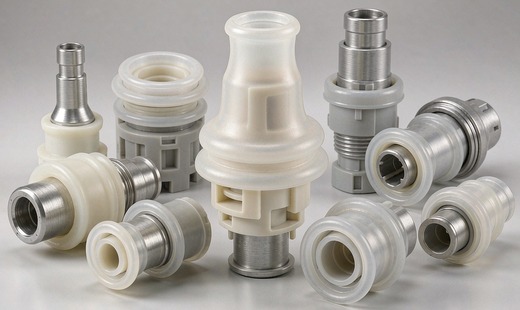
Figure 2 Macro close-up of an LSR precision overmolded high-voltage connector: micron-level tolerance and IP68 sealing structure
7. Battery Sealing: Three Lines of Defense
The traction battery is the most central and safety-critical component of a new energy vehicle. LSR precision overmolding takes on several roles in the battery system: ultra-thin gaskets between the upper and lower pack covers deliver IP68 dust and water resistance; explosion-proof valve overmolded seals stay structurally intact during thermal runaway; high-voltage terminal insulation boots block electrolyte penetration; and cell-level thermal buffer silicone pads absorb vibration and shock from driving.

Figure 3 Precision assembly workshop for new energy vehicle battery pack liquid silicone gaskets
8. Thermal Management: Heat Dissipation and Buffering Together
Thermal management is decisive for battery life and safety. Thermally conductive liquid silicone, through special fillers, keeps a high thermal conductivity — 1.6 to 2.4 W/mK is now mainstream — while retaining elasticity and compressibility. It is used for gap filling and potting between cell modules and the cooling plate, moving heat efficiently from the cells into the cooling system. Compared with conventional thermal grease, LSR thermal interface materials do not dry out and fail, working stably over a wide minus 45 to 180 degrees Celsius range and serving both heat dissipation and structural buffering.
9. Insulation for Electronic Control: Guardian of the High-Voltage Platform
The electronic control system integrates a large number of precision electronic devices — BMS battery management chips, DC/DC converters and inverters. LSR, with dielectric strength above 25 kV/mm and low dielectric loss, is widely used for busbar insulation and circuit board potting, effectively preventing short circuits and surge risk. Its low-stress cure also protects fine magnet wire from vibration damage, keeping the control system running reliably under complex conditions — an important pillar that makes the 800 V high-voltage platform workable.
10. High-Voltage Connection: Fixing the Weakest Link in Waterproofing
High-voltage connectors are among the most failure-prone weak points in a new energy vehicle. LSR precision overmolding can form metal terminals and the plastic housing together in one shot, creating a multi-lip waterproof seal structure that reaches IP68 waterproof insulation and long-term resistance to under-hood heat and arc corrosion. Compared with conventional two-shot molding, one-piece overmolding markedly reduces micro-seepage risk, holding yield steadily above 99 percent — which is why it has become the preferred route for leading automakers and Tier 1 suppliers tackling waterproofing in high-voltage fast-charge connectors.
11. Charging Systems: New Growth From Liquid-Cooled Fast Charging
Charging systems also depend on LSR precision overmolding. Charging gun heads and vehicle inlets molded in one piece from LSR withstand over ten thousand mating cycles and arc voltages above 10 kV, keeping charging safe and reliable. Charge point connector seals resist rain, snow, salt fog and extreme temperature swings, while multi-bore harness boots balance insulation with flexible assembly. As high-power liquid-cooled fast charging spreads, charging scenarios raise the bar for high-temperature resistance and insulation, opening up further room for growth.
12. Sensor Protection: The Invisible Shield for Intelligent Driving
The advance of autonomous and intelligent driving has multiplied the number of on-board sensors — millimeter-wave radar, LiDAR and cameras. LSR precision overmolding, with its clear, defect-free molding and excellent wave transmission, is used for radar encapsulation, camera lens waterproof seals and LiDAR cushioning protection. While keeping sensing signals free from interference, it provides dependable dust, water and shock protection for precision optical and RF devices — an indispensable link in the intelligent driving safety chain.

Figure 4 Collection of LSR precision overmolded seals for new energy vehicle three-electric systems
13. Flame Retardance: The Last Line of Defense in Thermal Runaway
Safety is the bottom line for new energy vehicles, and thermal runaway protection is the top priority. Flame-retardant liquid silicone meets UL 94 V-0 and is used for cell separators, module end plates and cable boots to slow flame spread. Further along, ceramifiable silicone converts to a ceramic structure above 600 degrees Celsius, forming a physical thermal barrier that can bring the radiant heat of a 1300 degrees Celsius flame down below 150 degrees Celsius. Against the backdrop of the new GB 38031-2025 regulation, precision overmolding suppliers with high bond strength above 2 MPa and ceramifiable coating capability are becoming scarce resources in the traction battery supply chain.
14. Compliance Standards: The Entry Bar for the Supply Chain
Entering the new energy vehicle supply chain requires compliance capability as a hard entry condition. Vehicle-level low VOC control and EU D4/D5/D6 volatile emission limits keep tightening, requiring suppliers to hold IATF 16949 quality systems, a full set of vehicle-specific testing and complete MES batch traceability. Leading manufacturers with fully independent process capability covering the whole range of silicone parts for battery, electronic control, chassis and cabin are taking the incremental orders from import substitution, while small workshops lacking compliance systems and testing capability are being cleared out faster — industry consolidation is speeding up.
15. Industry Trends: Four Clear Directions
Looking ahead, liquid silicone for new energy vehicles in precision overmolding shows four clear directions. First, LSR precision molding is accelerating replacement of conventional solid compression molding to become the mainstream process for three-electric system components. Second, flexible customization across many part numbers in small batches becomes the norm, favoring suppliers with flexible lines and shared mold libraries. Third, vertically integrated one-stop supply is becoming the procurement model automakers recommend. Fourth, 800 V high-voltage platforms, miniature sensing and ultra-thin battery seals keep pushing materials and processes forward. Liquid silicone precision overmolding is moving from backstage to the front of new energy vehicle manufacturing.
16. Henry Precision: The Quiet Strength Behind Smart Vehicles
As a company working deep in liquid silicone precision overmolding, Zhongshan Henry Precision Technology Co., Ltd. (Henry Precision) focuses on high-precision LSR injection molding and metal-plastic composite overmolding, forming a complete closed loop from tooling design and material evaluation to automated volume production. Whether it is a battery pack gasket, high-voltage connector overmolding, or sensing protection and thermal management parts, Henry Precision works to micron-level process and automotive-grade quality control, providing highly reliable sealing and protection for the three-electric systems of new energy vehicles.
Table of Contents


Get Your Custom Liquid Silicone Overmolding Solution in 3 Steps
Learn More

