













Can LSR Overmolding Pass Salt Spray Testing? Corrosion Resistance Explained


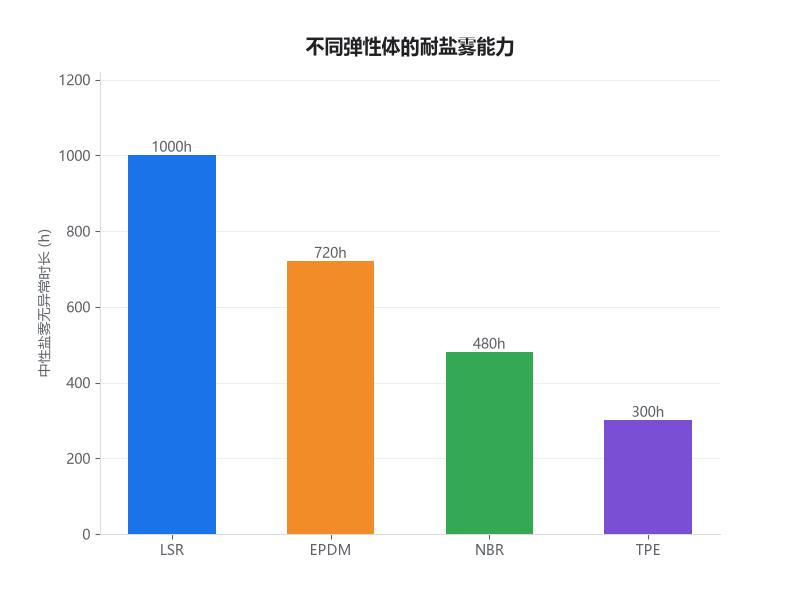
Overview: liquid silicone has excellent salt spray resistance in its own right — 500-1,000 hours of neutral salt spray without change is routine. Where an overmolded part fails, the weak point is usually not the silicone but corrosion of the metal insert, penetration along the interface, and galvanic corrosion of the substrate. Getting the assembly through salt spray requires designing the silicone, substrate and interface together.
The Silicone Is Not the Problem
The silicone backbone is a Si-O-Si structure with high bond energy and strong chemical inertness, insensitive to salt water, acid mist, ozone and oxidants. Tested to GB/T 10125 neutral salt spray (NSS, 5% NaCl, 35°C), a pure silicone specimen showing no change in appearance and less than 10% property loss at 1,000 hours is normal, and some grades go beyond 2,000 hours.
So if the test subject is a pure silicone part, salt spray is rarely the obstacle. The problem lies in the overmolded structure — the composite interface the silicone forms with metal or plastic is the weak link.
Three Failure Points
The first is corrosion of the metal insert. Salt mist tracks along the interface to the insert surface; even 304 stainless will pit in a chloride environment, and plain carbon steel or aluminium inserts are worse. The answer is 316L stainless or a passivation or plating treatment, combined with a structure where the silicone covers the insert completely with no exposed edge.
The second is capillary penetration along the interface. Where the bond to the substrate is inadequate, salt water creeps along the interface and spreads from the edge inward until the whole layer lifts. That demands 100% cohesive failure in bond testing, plus a waterproof lip at the edge to lengthen the penetration path. The third is galvanic corrosion: when the silicone contains conductive filler, or a carbon steel insert contacts a copper part, a galvanic cell forms and accelerates corrosion — avoid direct contact between dissimilar metals in the design.
How to Design the Structure
Effective measures include: increasing the overmold layer to 1.0 mm or more (lengthening the penetration path); designing a 0.3-0.5 mm step or groove at the substrate edge so the silicone forms a mechanical interlock; applying primer to the bonding face to raise interface density; and for parts with inserts, burying the insert fully inside the silicone to avoid a metal-air-silicone triple junction.
A hydrophobic additive can also be compounded into the silicone to lower water absorption. Standard LSR absorbs about 0.1%-0.3% water; hydrophobic treatment brings that below 0.05%, which helps long-term salt spray resistance.

How to Test
Choose test conditions to match the real service environment: neutral salt spray (NSS) 500-1,000 hours for marine or coastal use; copper-accelerated acetic acid salt spray (CASS) or cyclic corrosion testing (CCT, with humidity, drying and salt spray stages) for automotive parts, the latter being closer to real failure modes.
Judgement should not stop at whether rust is visible. Three things need measuring: appearance (no blistering, no lifting, no rust), bond strength (no more than 30% loss after salt spray), and sealing performance (retest air or water pressure on waterproof parts). Zhongshan Henry Precision Technology Co., Ltd. (Henry Precision) recommends a salt spray baseline early in the project, so structural problems surface before tooling is cut.

Table of Contents
Related News


Get Your Custom Liquid Silicone Overmolding Solution in 3 Steps
Learn More

