













Is LSR Overmolding the Same as Two-Shot Molding? The Process Difference


Overview: "two-shot molding", "overmolding" and "LSR overmolding" are often used interchangeably, but they differ fundamentally in material system, equipment configuration, tool structure and suitable applications. This article draws the boundaries between the concepts and sets out the basis for choosing a process in different situations.
Clearing Up the Concepts
Two-shot molding (also called 2K molding) generally means two thermoplastics injected in two stages on one machine, using a rotating tool or transfer mechanism. LSR overmolding joins a rigid substrate to liquid silicone, and the silicone side needs a dedicated LSR feed and cure system.
Both fall under the broad heading of "overmolding" or multi-material molding, but material system, equipment and process window are completely different — they cannot simply be equated.
Material System Differences
In two-shot molding both materials are thermoplastics (PC+TPU, ABS+TPE, for example), joined by molecular diffusion and mechanical interlocking in the melt, and set by cooling. The process is reversible — the material can be remelted.
Liquid silicone is a thermoset: the A and B components react by platinum-catalysed addition once mixed, forming an irreversible crosslinked network that will not melt again when heated. That difference is why LSR requires a cold runner (to prevent curing in the runner) combined with a heated cavity (to promote curing) — something thermoplastic two-shot molding does not need.
Equipment and Tooling
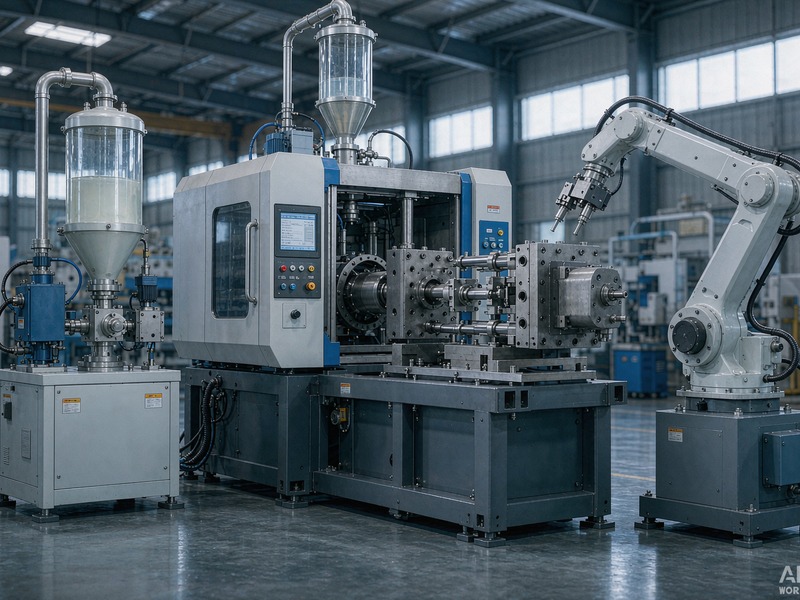
A two-shot machine has two injection units plus one rotating or transfer tool. An LSR overmolding line needs an injection machine (for the substrate) plus a dedicated LSR machine (cold runner, mixing system, vacuum unit), or an integrated two-material machine.
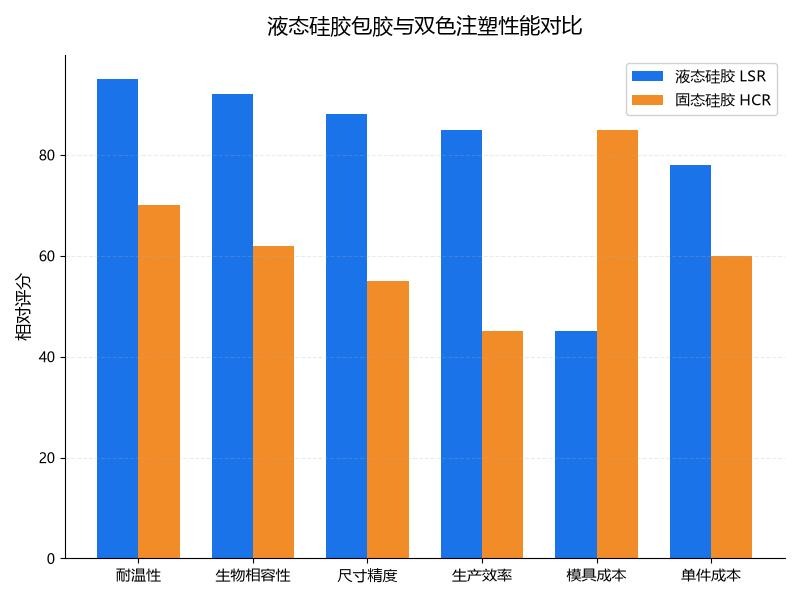
On tooling, an LSR tool needs a vacuum sealing structure, a cold runner system and corrosion-resistant mirror-finish steel, with tighter fitting accuracy (clearances typically ≤0.01 mm to prevent flash). All of this puts its cost above a conventional two-shot tool.
Performance and Applications
Two-shot molding wins on short cycle times (typically 30-60 seconds), relatively low cost, and flexibility in colour and hardness. It suits grip overmolding, keypads and decorative parts where temperature resistance and biocompatibility requirements are not extreme.
LSR overmolding wins on: a wide temperature range (-40°C to over 200°C), biocompatibility, low compression set, a soft feel that does not pick up dust, and excellent weathering and aging resistance. Medical devices, baby products, automotive sealing, waterproof structural parts and high-temperature components are its main territory.
How to Choose Sensibly
We suggest working through three questions in order: does the product need medical or food-contact certification? Does the service temperature exceed 100°C? Does it need long-term compression rebound or outstanding weathering resistance? If the answer to any one is "yes", LSR is generally the right choice. If all three are "no", two-shot molding gives better value.
Zhongshan Henry Precision Technology Co., Ltd. runs both two-material injection molding and LSR overmolding, so we can give an unbiased recommendation based on how the product is actually used rather than steering towards a single process.
Q: Can LSR be molded as fast as TPE?
A: No. Liquid silicone needs cure reaction time; a single cycle typically runs 40-120 seconds depending on wall thickness, longer than TPE overmolding. But LSR can be run multi-cavity, so per-part efficiency stays competitive.
Q: Can an existing two-shot tool be converted to silicone overmolding?
A: Generally not recommended. LSR needs a cold runner, vacuum system, corrosion-resistant steel and tighter fit accuracy; conversion cost approaches that of a new tool.
Q: How much does cost differ between the two processes?
A: On tooling, LSR typically runs 30%-80% higher. On unit cost the gap narrows at production volumes, and in high-temperature or medical applications LSR often has the lower total cost.
Table of Contents
Related News

Get Your Custom Liquid Silicone Overmolding Solution in 3 Steps
Learn More

