













Why LSR Overmolding Interfaces Fail: Root Causes of Debonding and Delamination, and Fixes


In medical LSR overmolding programs, bond failure at the soft-rigid insert interface is a frequent and difficult problem. Many samples pass peel testing, then debond or develop delamination that is hard to spot after volume production, sterilization or thermal cycling, causing sealing failure and holding up medical device registration.
Bond failure is rarely a single factor — material, incoming condition, process and aging all interact. Adjusting one parameter alone gives only temporary improvement, and the problem readily returns in production.
Core Failure Pain Points
There are two failure modes:
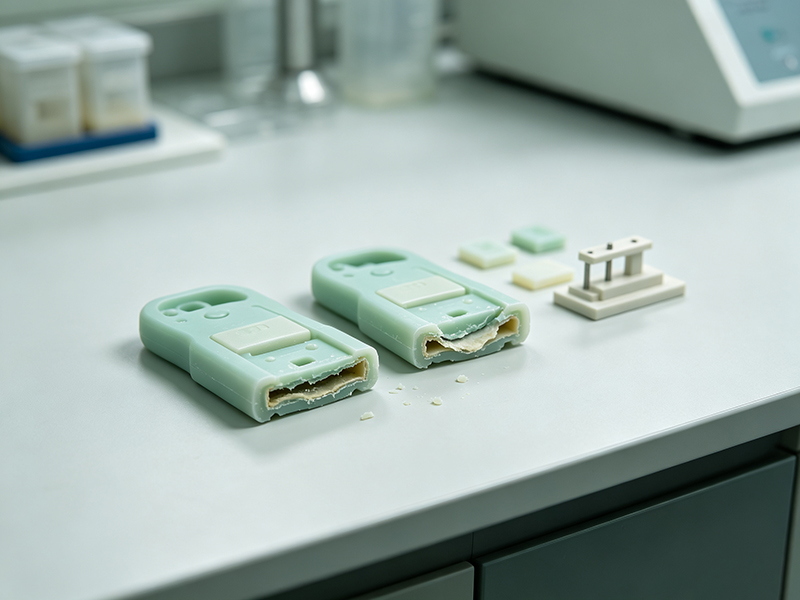
Visible debonding: the silicone lifts and peels away from the insert surface, easy to identify.
Hidden delamination: the part looks intact but micro gaps have formed at the interface, worsening under sterilization and pressure, and often surfacing only at the registration validation stage.
Main Causes
Substrate differences: PPSU and stainless steel bond readily, while PEEK and highly filled modified plastics are difficult to bond. Switching substrate grades directly changes bond performance.
Incoming insert contamination: release agent residue, oil or bloomed additives form a barrier layer that later treatment cannot remove, so incoming surface energy must be controlled.
Surface treatment variation: drift in plasma power or time causes under-activation or scorching of the substrate surface, while loss of control over primer mixing ratio, spray thickness or baking conditions creates a weak boundary layer.
Silicone grade matching: self-bonding LSR has substrate limits, so a self-bonding formulation cannot be relied on entirely.
Molding residual stress: incomplete curing, excessive mold temperature or excessive injection pressure leave internal stress that tears the interface after sterilization thermal cycling.
Aging amplifies defects: ethylene oxide, high-temperature high-pressure and radiation sterilization magnify tiny interface defects and trigger delamination.
Systematic Countermeasures
Medical overmolded components that contact the human body must be produced in an ISO Class 8 or cleaner cleanroom. Clean control is not just fit-out: it covers constant temperature and humidity, periodic airborne particle monitoring, gowning discipline, scheduled cleaning and disinfection of fixtures, and separating medical from general industrial production areas to avoid cross-contamination from ordinary silicone. LSR liquid silicone attracts dust readily, and tiny particles cause black spots and seal leaks in medical parts.
Assess substrate bond compatibility up front rather than changing insert grades casually.
Add surface contamination and surface energy checks on incoming inserts to control oil and release agent residue.
Lock down the plasma and primer process windows, fix key parameters, and monitor them by batch.
Add mechanical interlocks to the structure as a safety margin alongside chemical bonding.
Match the right medical LSR grade, optimize molding parameters, ensure complete curing and lower residual internal stress.
Reliability Validation Essentials
Do not test room-temperature peel strength alone. Medical-grade overmolding must complete peel retention after sterilization aging, thermal cycling and seal pressure testing, with attention on bond performance after aging.
Henry Precision steps in at the DFM stage to assess bonding risk, managing incoming material, process and aging validation as a closed loop to resolve LSR overmolding debonding and delamination.
Table of Contents


Get Your Custom Liquid Silicone Overmolding Solution in 3 Steps
Learn More

