













What Is the Minimum Order Quantity for LSR Overmolding? The Cost Logic Behind MOQ


Overview: there is no fixed standard for liquid silicone overmolding order quantities; they usually fall somewhere between 3,000 and 10,000 pieces. The point of an MOQ is to spread setup scrap, purge waste and machine startup cost — not to act as a hard gate. This article breaks down what MOQ consists of, what influences it, and how low-volume orders can work.
What Makes Up MOQ
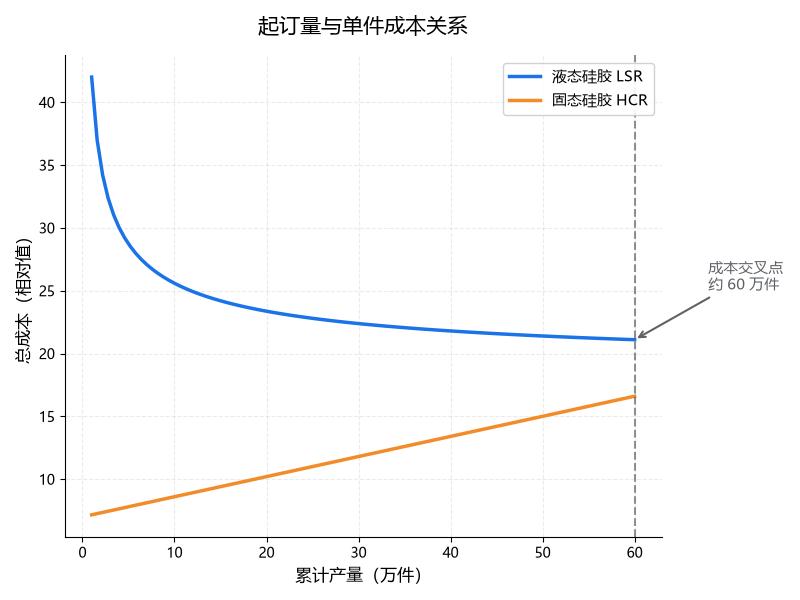
Startup cost in liquid silicone production is relatively fixed: every run requires purging the machine (cleaning out the previous material and colour masterbatch), setting parameters, and trial shots to confirm. That process generates scrap and labour. Purge waste typically runs 0.5-2 kg depending on the material and how big a colour change is involved.
When the order is too small, that fixed cost spread across each part becomes extremely high. Setting an MOQ is essentially a way of keeping unit cost inside a range the customer can accept.
Variables That Move MOQ
First, part weight: a micro seal weighing 0.5 g means 5,000 pieces is only 2.5 kg of material, so purge waste can exceed 30% of the total and MOQ usually starts at 10,000 pieces. A large part weighing 20 g means 5,000 pieces is 100 kg, and MOQ can drop to 1,000-3,000 pieces.
Second, colour and material changeover: natural or black carry low changeover cost, while special colours and medical-grade materials cost noticeably more to purge. Third, precision and inspection requirements: full inspection adds marginal cost that scales linearly with quantity, so it affects MOQ relatively little.
Sampling and Low Volume
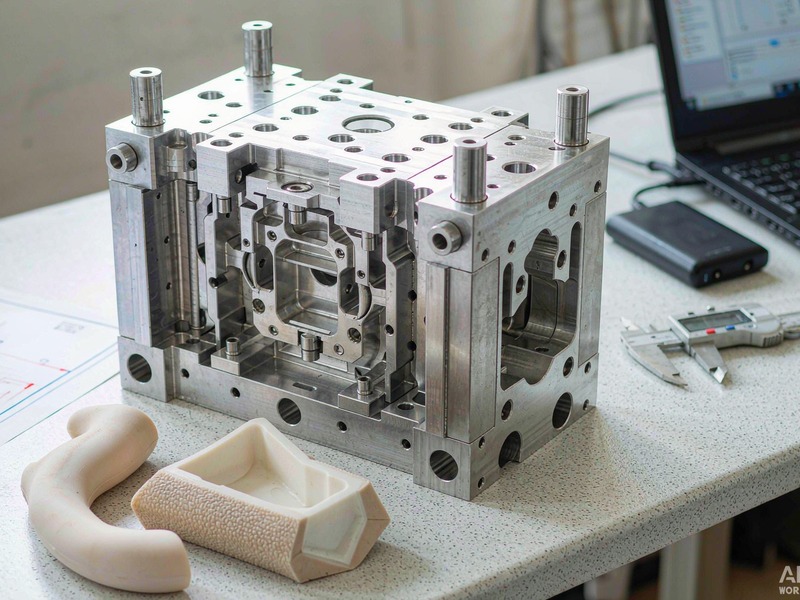
If you only need tens to a few hundred pieces, the sampling route fits better than production: use a prototype or soft tool for a small run. Unit price is higher, but you avoid the cost of production tooling and a production MOQ.
Zhongshan Henry Precision Technology Co., Ltd. offers a staged path from soft tool sampling and prototype tool validation through to production tooling, so customers can get physical samples at low cost while the market is still being validated.
How to Lower MOQ
Practical routes include: combining production with other orders (batching parts that share the same material and colour), accepting a longer lead time so the run can be slotted into a material change window, and choosing standard materials and colours to keep purge cost down.
If the part geometry allows it, you can also validate appearance and assembly in small batches with a thermoplastic elastomer (TPE) first, then move to LSR for production — bearing in mind that TPE and LSR differ in feel and performance.
Common Questions
Two things about MOQ are often misunderstood. First, MOQ is not a fixed company policy but a figure calculated from cost, and providing accurate part information usually produces a more workable number. Second, MOQ on the first order and on repeat orders can differ — with the tool and parameters settled, repeat orders usually accept lower quantities.
Zhongshan Henry Precision Technology Co., Ltd. supports long-term customers with more flexible minimum quantities on repeat orders when scheduling capacity allows.
Q: Can I order just 500 pieces?
A: Yes, through the sampling route using a soft or prototype tool, but unit price will be significantly higher than production pricing. If volume production is planned, evaluate the tooling approach at the same time.
Q: Can sampling and tooling fees be credited against the order?
A: Most suppliers allow partial credit once an agreed order volume is reached. The terms should be set out clearly in the contract to avoid disputes later.
Q: Why does changing colour mean renegotiating MOQ?
A: Because a colour change involves extra purging, and purging from dark to light is particularly expensive. Small adjustments within the same colour family usually do not affect MOQ.
Table of Contents


Get Your Custom Liquid Silicone Overmolding Solution in 3 Steps
Learn More

